

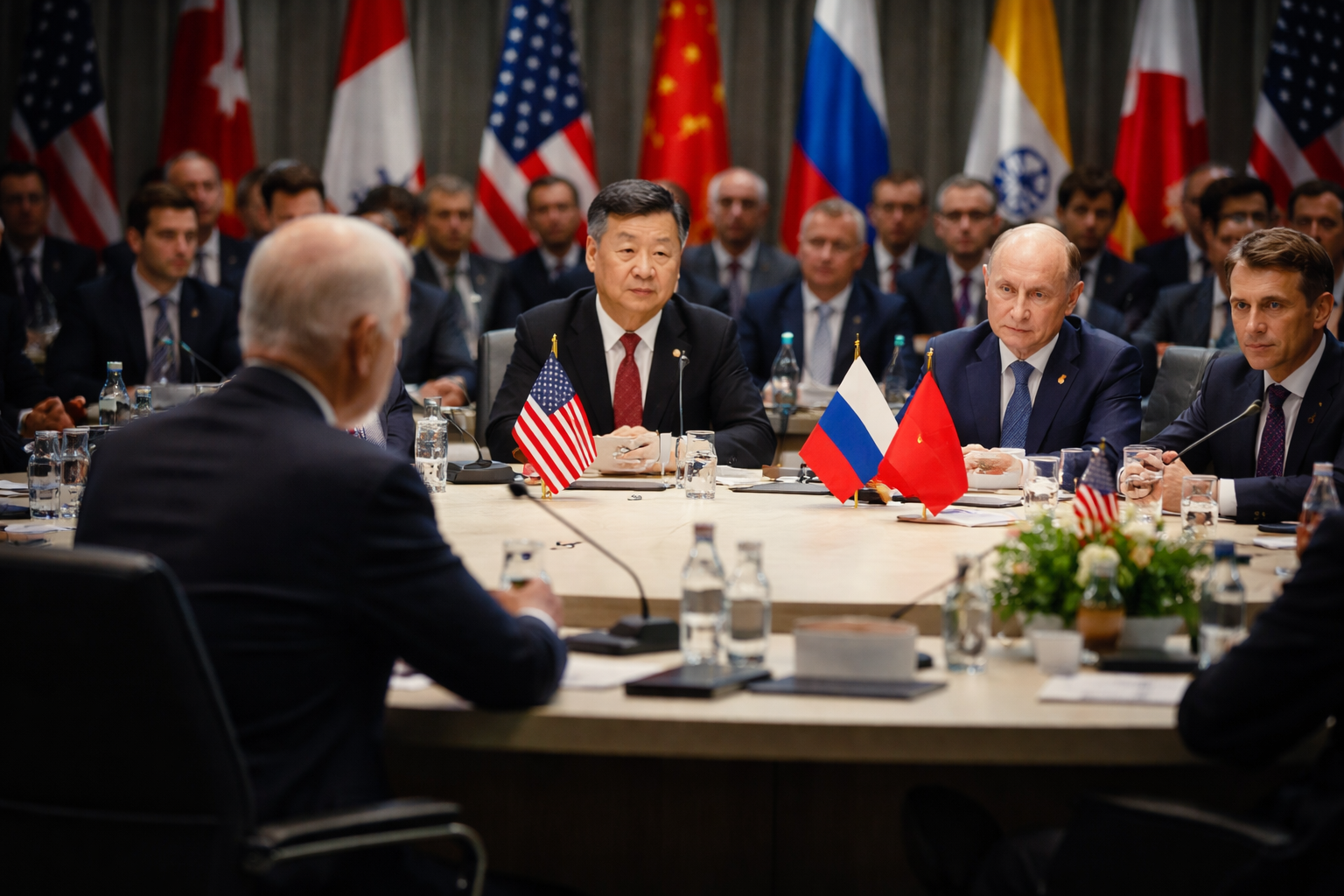
The global order is changing in ways that are measurable, documented, and increasingly unavoidable. What once appeared as a gradual redistribution of influence has now become a structural transformation, backed by economic data, academic research, and real-world geopolitical behavior.
Power is no longer concentrated in a single center. Instead, it is spreading across regions, reshaping markets, alliances, and institutions that once defined global stability.
From Unipolar to Multipolar: What the Research Shows
Academic research leaves little doubt that the post, Cold War unipolar system is fading.
A widely cited study in International Studies Quarterly finds that global power concentration has declined steadily since the early 2000s, driven by the relative economic rise of China, India, and several middle-income economies. The study concludes that the international system now exhibits multipolar characteristics, with multiple states capable of influencing global outcomes.
Similarly, research published in The Journal of Global Strategic Studies highlights that power today is multidimensional. Economic scale, technological capability, and network influence increasingly outweigh traditional military dominance.
Political analyst Fareed Zakaria summarized this shift succinctly: “This is not a world where America is weak, but one where others are strong.”
Economic Power Is the Core Driver of Global Influence
Economic capacity remains the most consistent predictor of long-term geopolitical power, a conclusion supported by decades of academic literature.
A meta-analysis in World Development shows that countries with sustained GDP growth above the global average for 20 years significantly increase their diplomatic influence, voting power in multilateral institutions, and ability to shape global norms.
Table 1. World’s Largest Economies (GDP Nominal, Projection 2026)
| Rank | Country | GDP (US$ Trillion) |
|---|---|---|
| 1 | United States | ~31.8 |
| 2 | China | ~20.6 |
| 3 | Germany | ~5.3 |
| 4 | India | ~4.5 |
| 5 | Japan | ~4.4 |
While the United States remains dominant in absolute terms, academic models increasingly emphasize growth momentum rather than size alone.
Growth Momentum Is Reshaping the Balance of Power
Research published in The Journal of Economic Perspectives shows that faster-growing economies accumulate influence disproportionately over time, even when starting from a lower base.
This explains the strategic rise of India and other emerging economies.
Table 2. Economic Growth Outlook (2026, % YoY)
| Region / Country | Growth Rate |
|---|---|
| Global Economy | ~3.0% |
| Advanced Economies | ~1.8% |
| Emerging Economies | ~4.0% |
| China | 3.9–4.5% |
| India | ~6.7% |
According to Asian Economic Papers, sustained high growth combined with demographic expansion gives countries leverage not only in trade, but also in global standard-setting and technology governance.
Markets Are Responding to Structural Geopolitics
Financial markets increasingly reflect these academic conclusions.
A study in The Journal of Finance finds that geopolitical fragmentation raises equity volatility and alters sectoral capital allocation, favoring industries tied to national security and supply-chain resilience.
Table 3. Sectors Gaining Strategic Importance
| Sector | Academic Driver |
|---|---|
| Defense & Aerospace | Rising interstate competition |
| Energy & LNG | Geopolitical risk pricing |
| Semiconductors | Technology sovereignty |
| Critical Minerals | Supply-chain security |
| Infrastructure | Regionalization of trade |
This aligns with findings from Review of International Political Economy, which notes that markets now price geopolitical alignment as a long-term risk factor, not a temporary shock.
Institutions Are Losing Relative Authority
Global institutions are not collapsing, but their influence is diluted.
Research in Global Governance argues that institutions such as the WTO and IMF face declining compliance because their governance structures reflect outdated power distributions. Emerging economies increasingly seek parallel frameworks rather than reform from within.
Political theorist Robert Kagan has warned that global order requires active maintenance. Without credible institutions, competition becomes harder to manage and more prone to escalation.
The Global South as a Strategic Actor
Academic consensus now recognizes the Global South as a driver, not a follower.
A comprehensive study in Third World Quarterly shows that middle powers increasingly adopt multi-alignment strategies, maximizing economic and political flexibility rather than choosing fixed alliances.
This behavior is reshaping diplomacy, trade negotiations, and global governance, especially in climate policy, infrastructure finance, and development lending.
Conflict in the Gray Zone
Power competition today rarely takes the form of direct military confrontation.
According to Security Studies, modern rivalry increasingly unfolds through cyber operations, economic coercion, sanctions, and technology controls. These “gray-zone” tactics lower the threshold for conflict while increasing systemic risk.
Political scientist Samuel P. Huntington anticipated this complexity, arguing that future conflicts would be shaped by deep structural and identity-based divisions rather than traditional battlefield wars.
What the Evidence Suggests About the Future
Across disciplines, economics, political science, and security studies, the conclusion is consistent:
- Power will be more distributed
- Growth will matter more than ideology
- Markets will remain sensitive to geopolitics
- Institutions must adapt or lose relevance
Countries that combine economic resilience, technological capacity, and diplomatic flexibility are best positioned to shape the next phase of global order.
A shifting world order is no longer a theoretical debate. It is documented in academic journals, reflected in economic data, and visible in global markets.
The era of uncontested dominance is giving way to a more competitive and negotiated system. Stability will depend not on who leads alone, but on how power is managed collectively.
The balance of power is already moving. The question is whether global governance can move with it.