

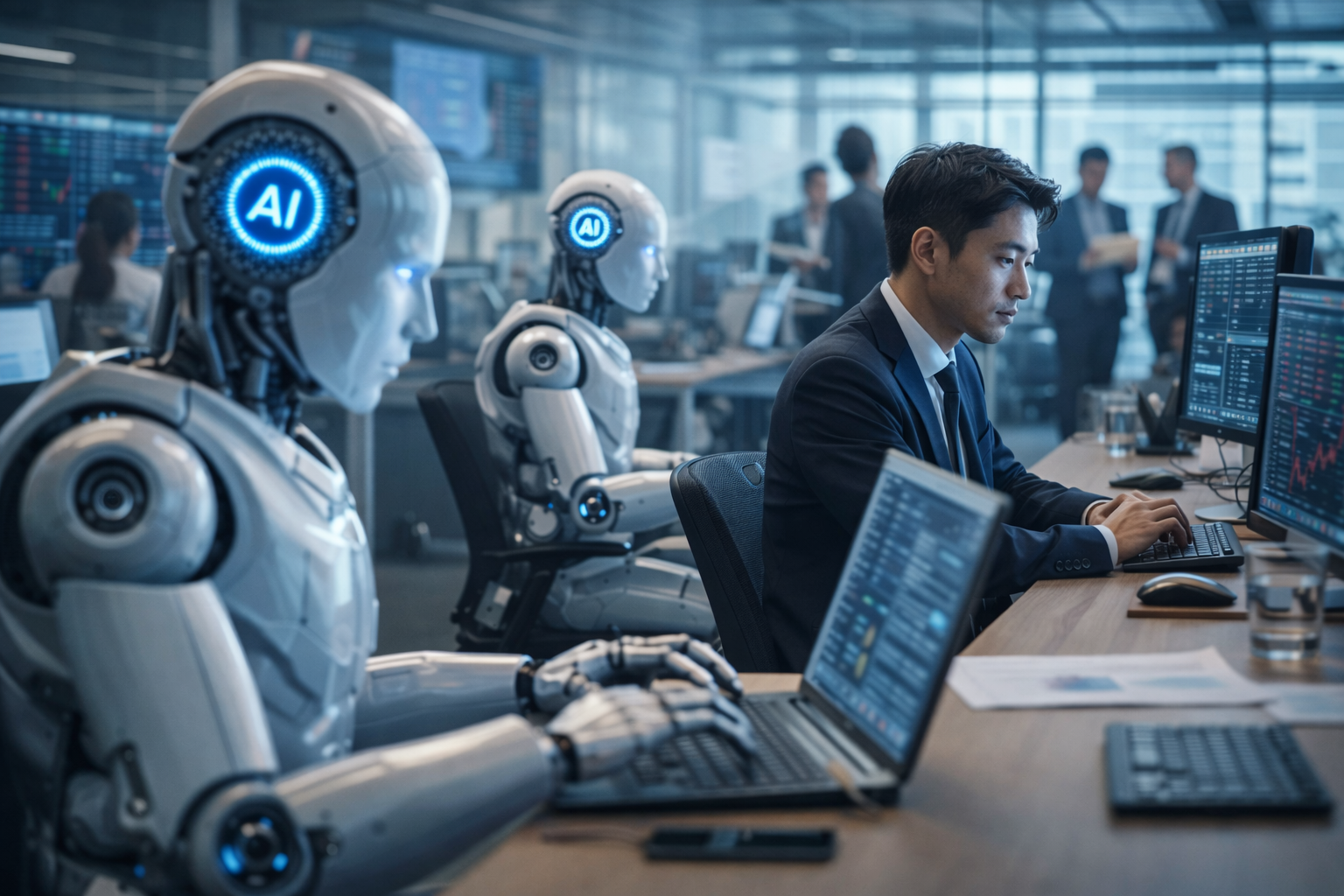
A Transformation Happening in Plain Sight
Artificial Intelligence is often portrayed as a dramatic force, robots taking jobs, algorithms replacing humans, and offices turning fully automated overnight. In reality, the transformation of the global workforce by AI is happening far more quietly. There are no sudden mass disruptions in most industries. Instead, AI is slowly embedding itself into everyday workflows, subtly changing how work is done, which skills are valued, and how organizations define productivity.
Rather than replacing workers outright, AI is reshaping tasks, redefining roles, and redistributing economic value. This quiet shift is already altering labor markets across the world, from high-income economies to developing countries, with long-term implications that extend well beyond technology.
1. AI Is Not Replacing Jobs, It Is Replacing Tasks
One of the most misunderstood aspects of AI’s impact on employment is the idea that entire jobs disappear at once. Scientific and economic research increasingly shows that AI primarily automates tasks, not occupations.
Most modern jobs consist of multiple components:
- Routine administrative work
- Data processing
- Decision-making
- Human interaction
- Creative or strategic thinking
AI excels at pattern recognition, prediction, and repetitive cognitive tasks, but it struggles with contextual judgment, ethical reasoning, and emotional intelligence. As a result, AI adoption tends to remove specific parts of a job while leaving the rest intact.
For example:
- Accountants now rely on AI for data reconciliation but still oversee compliance and interpretation.
- Journalists use AI for transcription or background research, not original reporting.
- Customer service agents handle complex cases while AI filters routine inquiries.
This task-level automation explains why workforce change feels gradual rather than explosive.
2. Productivity Gains Without Headcount Growth
One of the clearest effects of AI on the workforce is the decoupling of productivity from employment growth. Historically, rising productivity often led to more jobs. AI disrupts this pattern.
Companies can now:
- Produce more output
- Serve more customers
- Analyze more data
without hiring proportionally more workers.
This does not always lead to layoffs. Instead, organizations often:
- Freeze hiring
- Redesign roles
- Consolidate responsibilities
The result is a workforce that becomes leaner but more output-intensive. Employees are expected to manage broader scopes of work, supported by AI systems that reduce manual effort.
Over time, this trend reshapes labor demand, especially for entry-level and routine positions that once served as stepping stones in many careers.
3. The Changing Value of Skills in the AI Era
As AI absorbs repetitive cognitive labor, the global workforce is undergoing a revaluation of skills. Technical ability alone is no longer enough, nor is traditional experience in narrowly defined roles.
Skills gaining importance include:
- Critical thinking and judgment
- Cross-functional understanding
- Ability to supervise or validate AI outputs
- Communication and interpretation
- Ethical awareness and accountability
Interestingly, many of these are human-centric skills, not purely technical ones.
At the same time, AI literacy is becoming a baseline requirement. Workers are not expected to build AI models, but they are increasingly expected to:
- Understand AI limitations
- Use AI tools responsibly
- Interpret AI-generated insights
This creates a new category of workers: AI-enabled professionals, not engineers, but people who know how to work effectively alongside intelligent systems.
4. Reskilling Becomes a Permanent Feature of Work
In previous industrial transitions, reskilling happened in phases, a generation would retrain, then stability would return. AI breaks this cycle.
Because AI systems continuously improve, skills now have a shorter shelf life. What is valuable today may be partially automated tomorrow. As a result, learning is no longer a one-time investment but a permanent requirement.
Organizations are responding by:
- Shifting from degree-based hiring to skill-based evaluation
- Offering continuous internal training
- Investing in modular learning instead of long programs
For workers, this means career stability increasingly depends on adaptability, not tenure. The global workforce is moving toward a model where learning and working are no longer separate phases of life.
5. Sectoral Differences: Uneven Impact Across Industries
AI does not affect all sectors equally. Its impact depends on how predictable, digitized, and data-driven tasks are within an industry.
Highly Impacted Sectors
- Finance and accounting
- Customer support
- Logistics and supply chain
- Marketing and advertising
These fields experience rapid task automation and workflow redesign.
Moderately Impacted Sectors
- Healthcare
- Education
- Law
- Engineering
AI assists professionals but rarely replaces human judgment.
Lower Immediate Impact
- Skilled trades
- Care-based professions
- Creative leadership roles
These rely heavily on physical presence, trust, or originality.
This uneven impact creates labor market polarization, where some workers see rapid productivity gains while others face stagnation or displacement.
6. Quiet Workforce Reduction Through Structural Change
One of the most overlooked effects of AI is how it enables workforce reduction without layoffs.
Instead of firing employees, companies may:
- Not replace departing staff
- Merge roles
- Reduce contractor reliance
- Outsource fewer tasks
This approach avoids public backlash while still lowering labor costs over time.
For workers, this can feel confusing: jobs disappear not because someone was replaced by AI, but because the role was slowly redesigned out of existence.
7. Global Implications: Developed vs. Developing Economies
AI’s workforce impact differs sharply between countries.
In advanced economies
- AI complements high-skill labor
- Wages rise for AI-enabled professionals
- Middle-skill jobs face pressure
In developing economies
- AI threatens offshoring-based jobs
- Routine digital labor becomes less competitive
- Skill gaps widen faster
This raises concerns about global inequality, as countries that fail to adapt their education and labor systems may fall further behind in the AI-driven economy.
8. Psychological and Cultural Shifts at Work
Beyond economics, AI is reshaping how people experience work.
Common changes include:
- Increased performance monitoring
- Reduced tolerance for errors
- Faster decision cycles
- Higher cognitive load
While AI reduces manual effort, it can also increase mental pressure. Workers are expected to make better decisions faster, often with AI recommendations that must be interpreted rather than blindly trusted.
This creates a new form of stress, not physical, but cognitive and ethical, especially in high-stakes professions.
9. The Future of Human Work in an AI-Driven World
The long-term future of work will not be defined by humans versus machines, but by how responsibilities are divided.
Humans are likely to remain central in:
- Oversight and accountability
- Ethical decision-making
- Complex problem framing
- Creativity and social interaction
AI will increasingly handle:
- Pattern detection
- Optimization
- Prediction
- Repetitive cognitive tasks
The most resilient workers will be those who can translate human goals into machine-assisted processes, acting as bridges between intention and automation.
A Quiet Revolution With Lasting Consequences
Artificial Intelligence is not dramatically overturning the global workforce overnight. Instead, it is quietly reshaping it, task by task, role by role, decision by decision. This subtle transformation makes it more dangerous to ignore and more important to understand.
The evidence is clear:
- AI changes what people do, not just whether they work
- Skills matter more than job titles
- Continuous learning is no longer optional
- Human judgment remains essential
The future of work will belong not to those who resist AI, nor to those who blindly adopt it, but to those who learn how to work intelligently alongside it.