

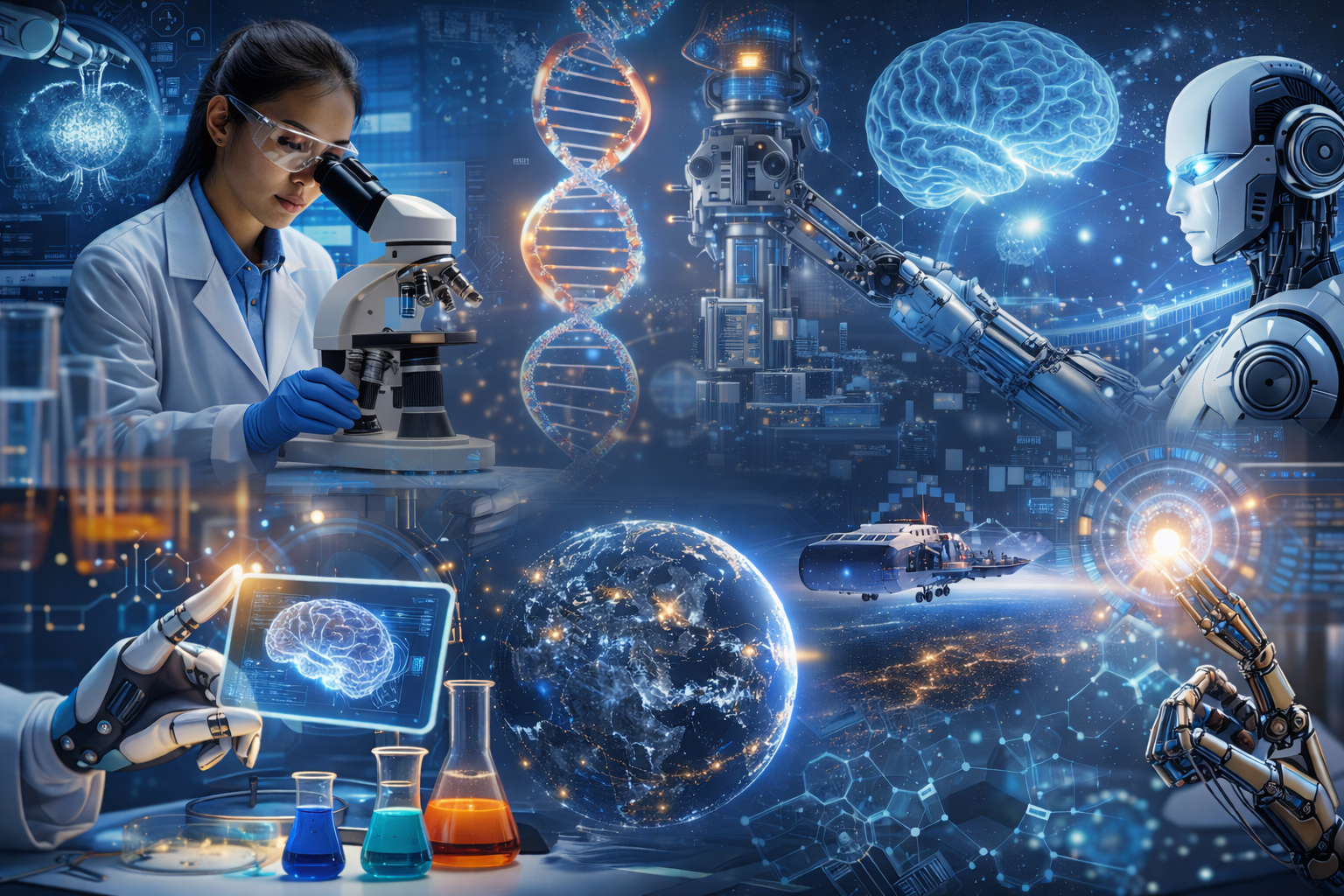
Scientific breakthroughs often sound distant and abstract. Many people imagine laboratories, complex formulas, and research papers written for experts only. In reality, science quietly shapes daily life. It influences health, technology, energy use, and even how societies solve global problems.
As the world approaches 2026, scientific progress is accelerating across multiple fields. Advances in artificial intelligence, medicine, climate science, and space exploration are no longer experimental ideas. Many are transitioning into real-world applications that may redefine how people live and work.
This article explores the most important science breakthroughs in 2026, explaining what they are, why they matter, and how they could shape the future.
Why Science Breakthroughs in 2026 Matter
Scientific progress drives economic growth and social development. Each breakthrough builds upon years of research, collaboration, and experimentation. When discoveries reach practical use, their impact often extends beyond science itself.
In 2026, breakthroughs are especially significant because they address global challenges. These include aging populations, climate change, energy demand, and rising healthcare costs. According to international research organizations, innovation remains a key factor in long-term global stability.
Understanding these developments helps societies prepare for change rather than react to it.
Artificial Intelligence Enters a New Scientific Era
Artificial intelligence continues to transform scientific research. By 2026, AI systems are expected to play a deeper role in discovery itself, not just data analysis.
Researchers use AI to simulate chemical reactions, model complex biological systems, and accelerate drug discovery. In physics and materials science, machine learning helps identify patterns that humans might miss.
These developments shorten research timelines and reduce costs. However, they also raise concerns about transparency, bias, and accountability. Ethical frameworks and human oversight remain essential as AI becomes more autonomous.
Medical Science and Precision Healthcare
One of the most impactful science breakthroughs in 2026 appears in healthcare. Precision medicine is moving closer to mainstream practice.
Advances in genomics allow doctors to tailor treatments based on individual genetic profiles. This approach improves effectiveness and reduces side effects. Researchers are also refining gene-editing technologies to address inherited diseases at their source.
In addition, wearable devices and digital diagnostics support early detection and preventive care. These tools reduce strain on healthcare systems while improving patient outcomes.
Medical science in 2026 focuses not only on treating illness, but on preventing it.
Climate Science and Clean Energy Innovation
Climate science remains one of the most urgent research areas. In 2026, breakthroughs in renewable energy, battery storage, and climate modeling are expected to accelerate environmental solutions.
Scientists are improving energy storage systems, making solar and wind power more reliable. Hydrogen technologies show potential for reducing emissions in heavy industry and transportation.
At the same time, advanced climate models improve predictions of extreme weather. Better forecasting supports disaster preparedness and reduces economic damage.
These discoveries help bridge the gap between environmental responsibility and economic growth.
Space Science and Exploration
Space science continues to expand human understanding of the universe. By 2026, missions exploring the Moon, Mars, and deep space are expected to deliver new data.
Improved telescope technology allows scientists to study distant galaxies and exoplanets in greater detail. These observations contribute to fundamental questions about cosmic origins and the possibility of life beyond Earth.
Meanwhile, space-based technologies support life on Earth. Satellites improve communication, navigation, and climate monitoring.
Space exploration in 2026 reflects growing collaboration between governments, research institutions, and private companies.
Materials Science and Nanotechnology
Materials science is a quiet driver of innovation. In 2026, advances in nanotechnology and advanced materials are expected to enable lighter, stronger, and more sustainable products.
Researchers develop materials that improve energy efficiency, medical implants, and electronic devices. Some materials adapt to environmental conditions, while others reduce waste through durability.
These breakthroughs support progress across industries, from construction to healthcare and transportation.
Neuroscience and Brain Research
Understanding the human brain remains a major scientific challenge. Advances in neuroscience continue to reshape knowledge of cognition, behavior, and mental health.
By 2026, improved imaging and computational models provide deeper insight into neurological disorders. This progress supports better treatment strategies for conditions such as Alzheimer’s disease and depression.
Brain-computer interfaces also advance gradually. Although still experimental, they offer hope for restoring communication or movement in patients with severe neurological damage.
Collaboration as a Catalyst for Discovery
Modern scientific breakthroughs rely heavily on collaboration. International research networks, shared data platforms, and interdisciplinary teams accelerate progress.
Open science initiatives increase transparency and allow researchers to build on each other’s work. This collaborative approach reduces duplication and improves efficiency.
However, cooperation also requires shared ethical standards and responsible governance.
Ethical Challenges and Scientific Responsibility
Every breakthrough carries responsibility. Misuse of technology, unequal access, and unintended consequences remain real risks.
Ethical considerations must evolve alongside innovation. Public understanding and evidence-based policy help guide responsible application of scientific discoveries.
The future depends not only on what science can achieve, but on how societies choose to apply it.
What Science Breakthroughs in 2026 Mean for the Future
Scientific discoveries in 2026 influence daily life in tangible ways. They shape healthcare quality, environmental sustainability, economic opportunity, and technological access.
From smarter medical treatments to cleaner energy and deeper space exploration, science expands the boundaries of what is possible.
Awareness of these breakthroughs helps individuals and institutions adapt with confidence.
Science as a Foundation for the Future
The science breakthroughs of 2026 reflect human curiosity and collective effort. They show how knowledge transforms challenges into solutions.
Science alone does not determine the future. Decisions, values, and cooperation shape outcomes.
Yet one conclusion remains clear. Science will continue to play a central role in shaping the world ahead.