

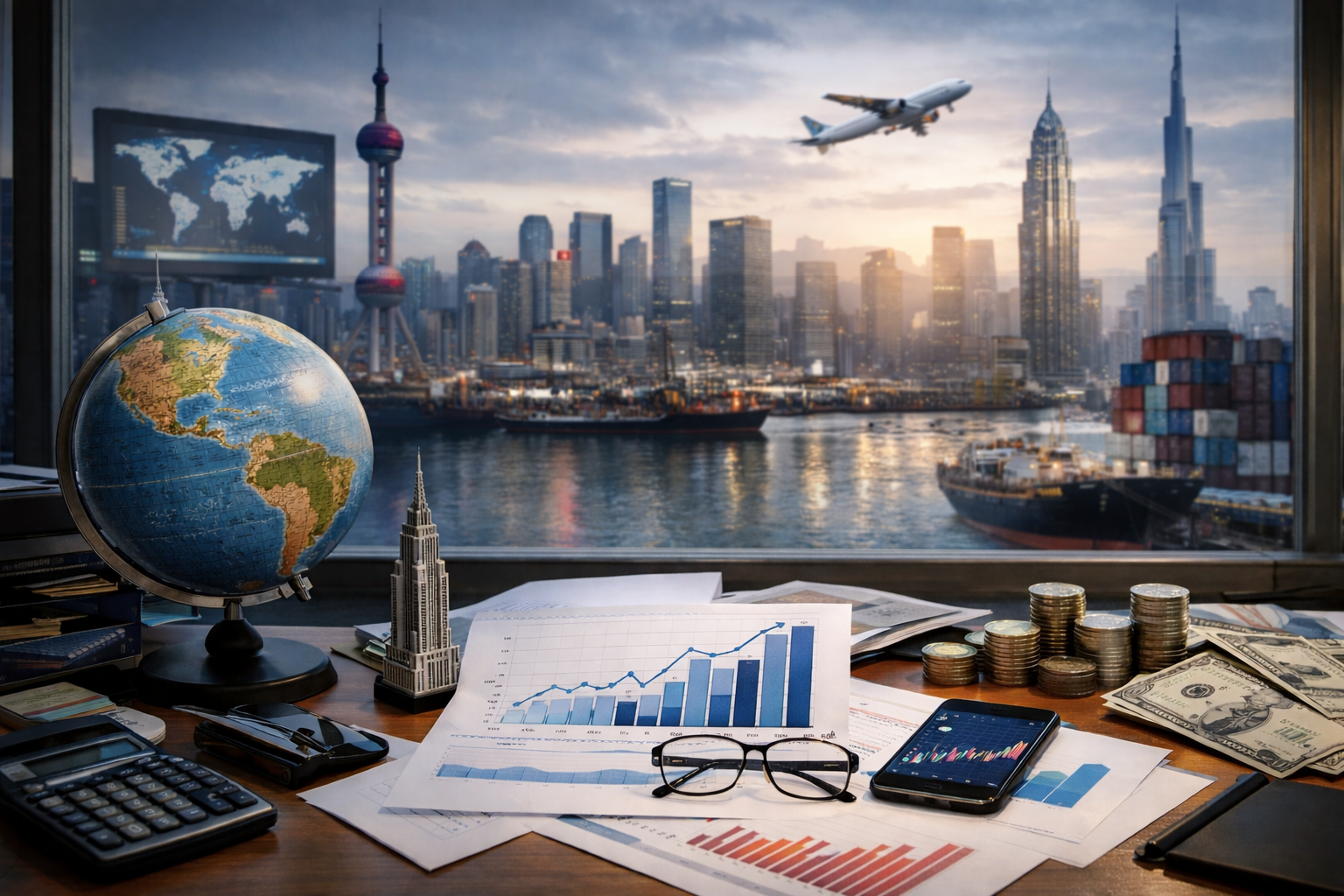
Let’s be honest, when people hear the phrase global economy, many immediately think of complicated charts, financial jargon, and discussions meant only for economists in suits. But the truth is far simpler and much closer to everyday life. The global economy shapes job opportunities, prices at the supermarket, interest rates, business growth, and even how secure people feel about their future.
As the world moves toward 2026, economic conditions are entering a new phase. The shock of the pandemic has faded, inflation pressures are easing in many countries, and technology is reshaping how businesses operate. At the same time, risks remain. Geopolitical tensions, climate challenges, debt burdens, and rapid technological change continue to test global stability.
In this article, we will talk like real people, not like a textbook. We will explore what experts expect from the global economy in 2026, where growth is likely to come from, what risks could slow progress, and why all of this matters to individuals, businesses, and governments.
Ready? Let’s take a clear look at the economic road ahead.
Why the Global Economy in 2026 Matters
The global economy is more connected than ever. What happens in one country rarely stays there. Supply chains cross borders, financial markets react instantly, and consumer confidence spreads through digital platforms.
According to the World Bank and the International Monetary Fund, global economic growth in 2026 is expected to remain moderate but stable, with projections ranging between 2.6% and 3.0%. This level of growth may sound small, yet it represents trillions of dollars in output, millions of jobs, and major shifts in global influence.
In simple terms, 2026 is not expected to be a boom year. However, it is also not predicted to be a crisis year. Instead, it is shaping up as a period of adjustment, adaptation, and strategic decision-making.
1. Global Growth Outlook: Steady, but Uneven
One important thing to understand about the global economy is that growth is never evenly distributed. Some regions expand faster, while others struggle to keep pace.
Advanced Economies
In advanced economies, such as the United States, Japan, and much of Western Europe, growth in 2026 is projected to remain modest. Aging populations, high public debt, and slower productivity growth continue to limit expansion.
The United States is expected to show relative resilience. Consumer spending, innovation, and strong labor markets may support growth near 2%, depending on monetary policy and political stability. Meanwhile, Europe faces more structural challenges, including energy transitions and productivity gaps, which may keep growth closer to 1.5%.
Emerging and Developing Economies
Emerging markets are expected to grow faster than advanced economies. Countries in Asia, particularly India and Southeast Asia, are projected to benefit from younger populations, digital transformation, and expanding middle classes.
China remains a key driver of global growth, although its pace is slowing compared to previous decades. Structural reforms, domestic consumption, and exports will determine how strong its contribution is in 2026.
Overall, emerging economies are expected to grow between 4% and 5%, helping support global demand and trade.
2. Inflation and Interest Rates: A Calmer Environment
After years of high inflation, many countries are finally seeing price pressures ease. Central banks have raised interest rates aggressively since 2022, and those policies are now having an effect.
By 2026, inflation in many major economies is expected to move closer to central bank targets. This shift creates room for more balanced monetary policy, although rates are unlikely to return to the extremely low levels seen before the pandemic.
Lower inflation helps households regain purchasing power. At the same time, stable interest rates improve business confidence and long-term investment planning.
However, inflation risks have not disappeared completely. Energy prices, food supply disruptions, and geopolitical shocks could still trigger sudden increases.
3. Technology and Artificial Intelligence as Growth Drivers
One of the most powerful trends shaping the global economy in 2026 is artificial intelligence (AI). Unlike previous technological waves, AI affects nearly every sector at once.
AI is expected to:
- Increase productivity in manufacturing and services
- Reduce operational costs for businesses
- Improve decision-making through data analysis
- Transform education, healthcare, and finance
According to economic research institutions, widespread AI adoption could add trillions of dollars to global GDP over the next decade. In 2026, early gains are likely to become more visible across industries.
However, technology also creates disruption. Many jobs will change, and some roles may disappear. Without proper training and policy support, inequality could widen between skilled and unskilled workers.
4. Global Trade and Supply Chains in Transition
Global trade is no longer just about efficiency. In recent years, governments and businesses have started prioritizing resilience, security, and regional partnerships.
By 2026, supply chains are expected to become:
- More diversified
- Less dependent on single countries
- More regionalized
This shift reduces vulnerability to shocks but may increase costs. As a result, trade growth is expected to continue, but at a slower pace than before globalization peaked.
Countries that invest in infrastructure, logistics, and digital trade systems are more likely to benefit from these changes.
5. Debt Levels and Financial Stability Risks
Public and private debt levels remain high across many regions. Governments borrowed heavily during crises to protect jobs and support economies.
In 2026, debt sustainability will remain a major concern, especially for developing countries. Higher interest rates increase borrowing costs, making debt repayment more challenging.
If not managed carefully, debt pressures could limit public spending on health, education, and infrastructure. Financial stability will depend on sound fiscal policies and international cooperation.
6. Climate Change and the Green Transition
Climate-related risks are becoming economic risks. Extreme weather events disrupt production, raise insurance costs, and reduce agricultural output.
At the same time, the transition to a green economy creates opportunities. Investments in renewable energy, electric vehicles, and sustainable infrastructure are expected to grow significantly by 2026.
Countries that lead in green technology could gain competitive advantages, while those that delay adaptation may face higher long-term costs.
7. Labor Markets and Demographic Shifts
Labor markets in 2026 will reflect long-term demographic trends. Many advanced economies face labor shortages due to aging populations. Meanwhile, younger populations in developing countries seek employment opportunities.
Automation and AI will change job requirements, increasing demand for digital and analytical skills. Education and reskilling programs will play a crucial role in maintaining economic stability.
Strong labor markets support consumer confidence. Weak or mismatched labor markets, however, can slow growth and increase social tension.
8. Geopolitical Risks and Policy Uncertainty
Geopolitical tensions remain one of the biggest threats to global economic stability. Trade disputes, regional conflicts, and political polarization can disrupt markets quickly.
Policy uncertainty also affects investor confidence. Sudden changes in regulation, taxation, or trade policy can delay investment decisions and slow growth.
In 2026, cooperation between major economies will be critical to maintaining stability and preventing global fragmentation.
9. What the Global Economy in 2026 Means for Individuals
All of these trends may sound distant, but they affect daily life in real ways.
Economic conditions influence:
- Job availability and wage growth
- Prices of food, energy, and housing
- Access to credit and loans
- Business opportunities and investments
A stable global economy supports personal financial security. A fragile one increases uncertainty.
10. Growth Projections at a Glance
Here is a simplified snapshot of expected trends:
- Global GDP growth: Around 2.6% – 3.0%
- Advanced economies: Slower growth, stable inflation
- Emerging markets: Faster expansion, higher potential
- Technology: Major productivity driver
- Risks: Debt, geopolitics, climate shocks
A Year of Balance and Decisions
The global economy in 2026 is not defined by extremes. It sits between recovery and reinvention. Growth is expected to continue, but challenges remain close to the surface.
Success will depend on smart policies, responsible innovation, and international cooperation. Countries that invest in people, technology, and sustainability are more likely to thrive.
For individuals and businesses alike, understanding these trends helps with better planning and smarter decisions. Because in the end, the global economy is not just numbers on a screen. It is the system that shapes everyday life around the world.